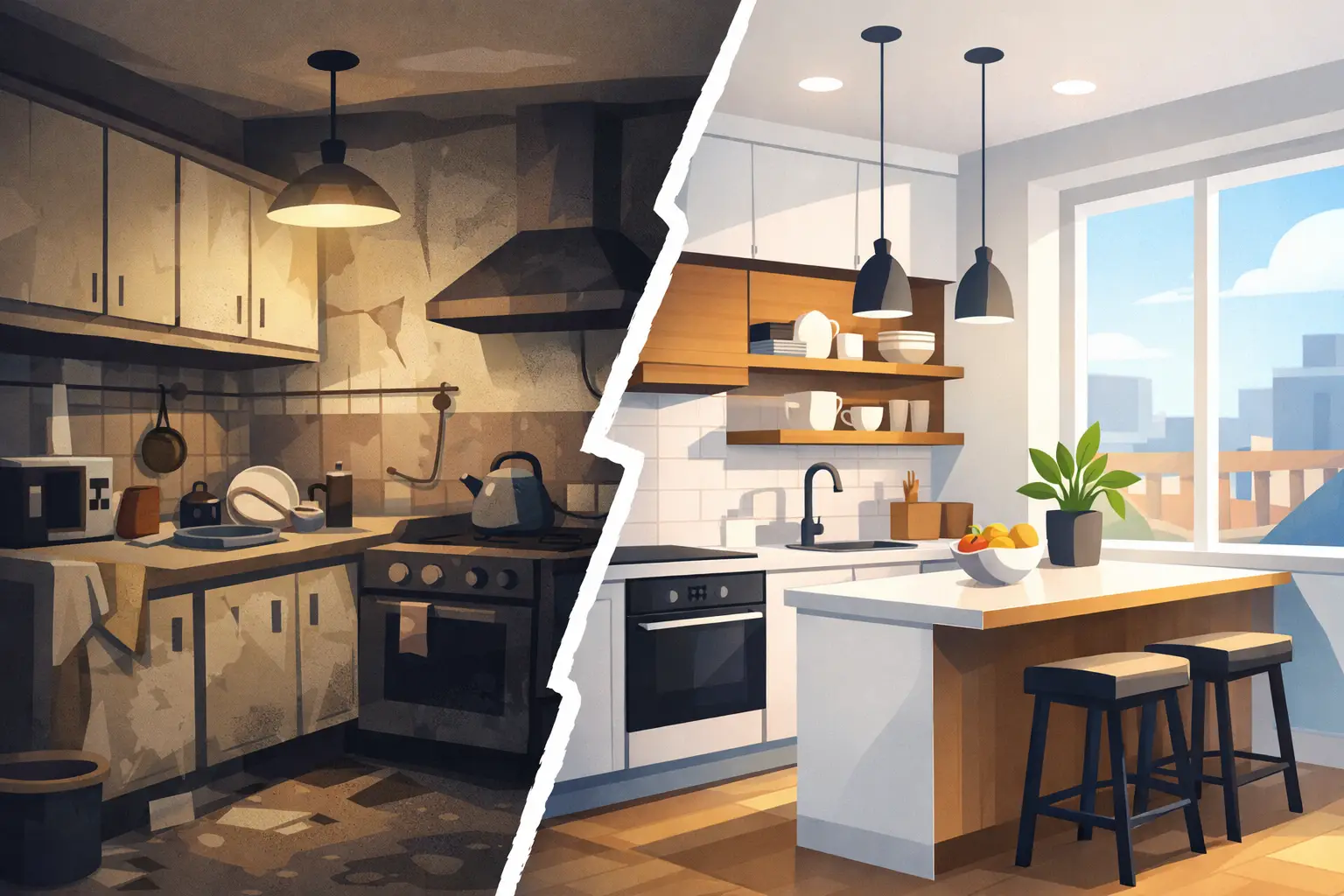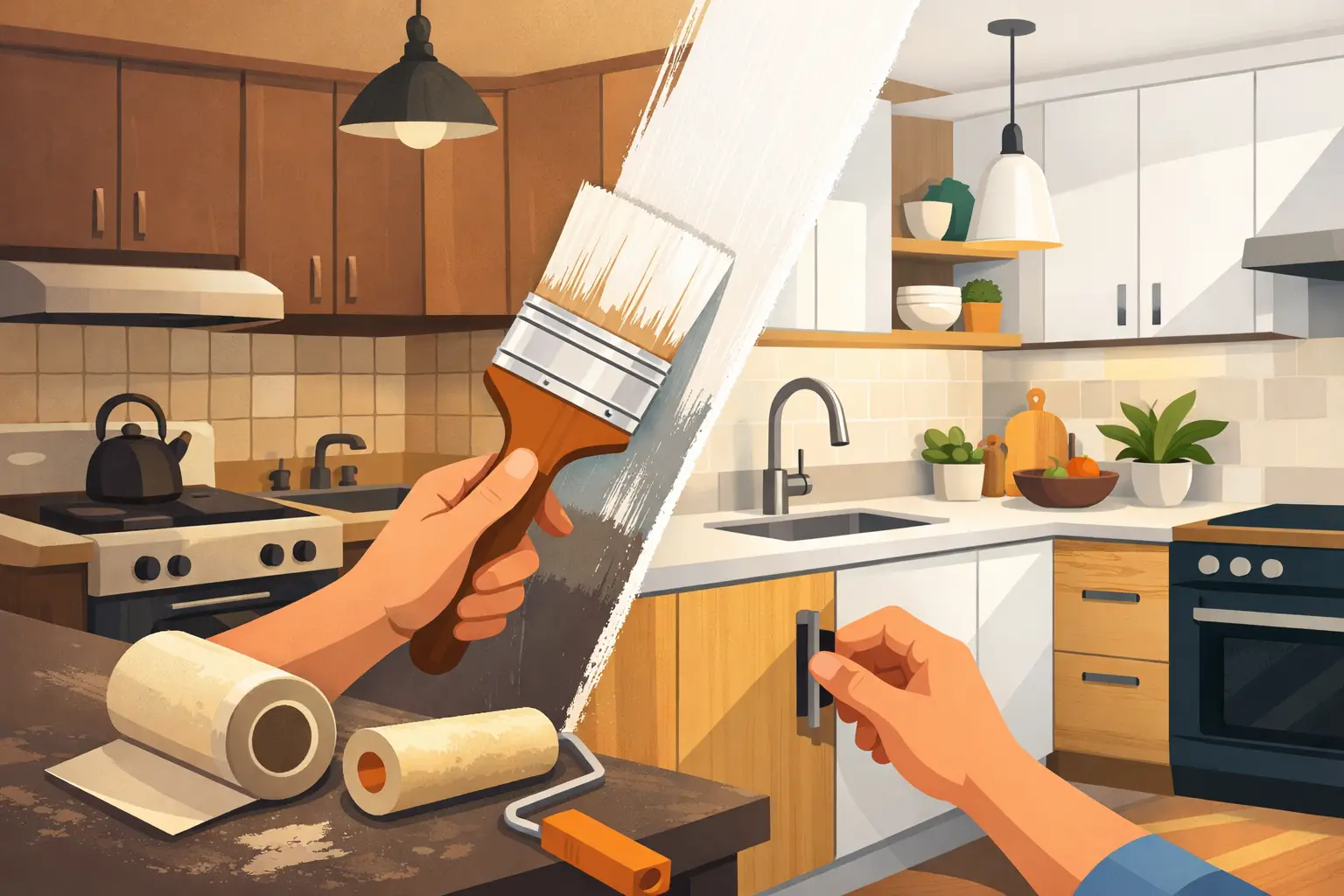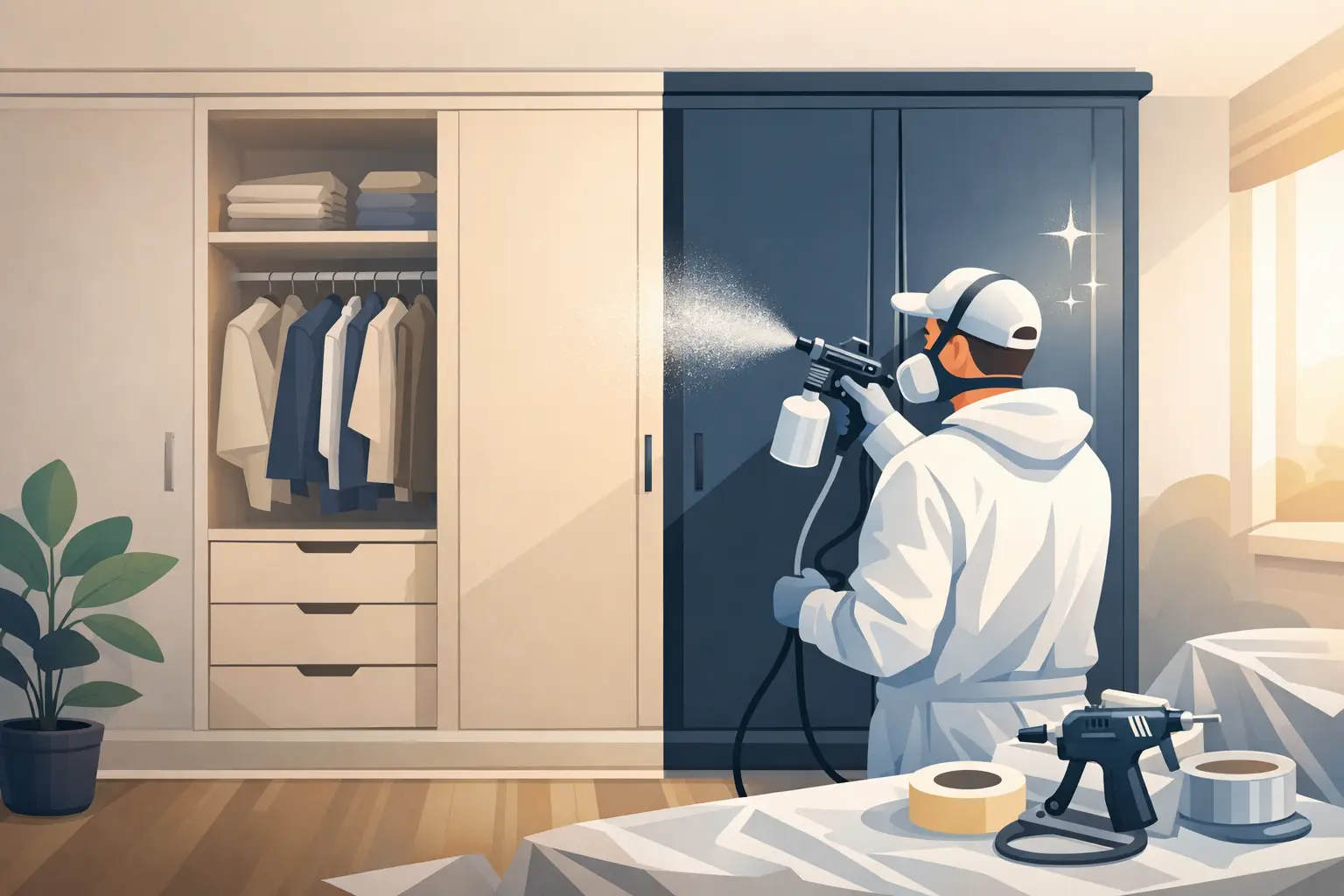
You open the kitchen door, look at the cupboards, and you can see it instantly – the colour has dated, the finish has gone dull, and the doors feel tired even if the kitchen itself is still solid. The obvious question follows: can you respray kitchen cabinets in place, without taking everything apart and turning the house upside down?
Yes – it’s possible in certain situations. But the real answer (the one that saves you money and protects the final finish) is: it depends on what you mean by “in place”, what your cabinets are made of, and how fussy you are about the end result. A professional spray finish has a very specific look – smooth, even, factory-like – and that depends on preparation, access, and control.
Can you respray kitchen cabinets in place?
If by “in place” you mean leaving the cabinet boxes fixed to the wall, then yes – that’s standard. Cabinet frames and carcases are usually resprayed where they are, because removing them is basically a renovation.
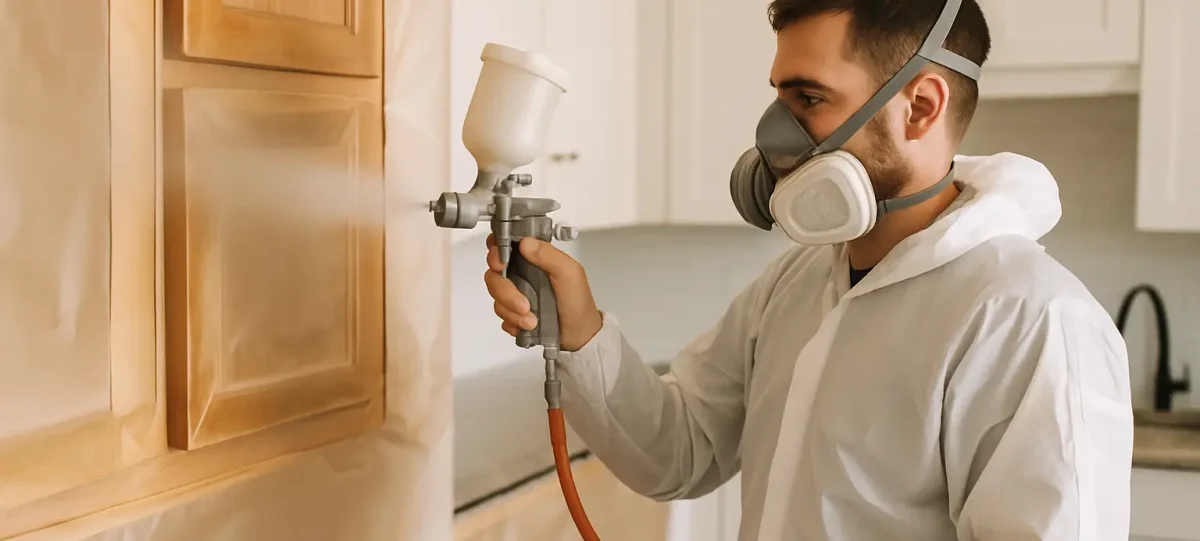
If you mean spraying the doors and drawer fronts while they’re still hanging on the hinges, that’s where it becomes a judgement call. It can be done, but it’s rarely the best route if you want a flawless finish, crisp edges, and paint that lasts.
The biggest difference is access. When doors stay on, you’re trying to spray around hinges, handles, tight corners, and closing edges, all while working vertically. That makes it harder to get consistent coverage without overspray catching where it shouldn’t.
When respraying in place can work well
There are times when an in-place respray is a reasonable option, particularly if the kitchen is straightforward and expectations are realistic.
If you have very simple flat doors, minimal detail, and plenty of space around each unit, a careful in-place approach can refresh the look. It also suits utility rooms or investment properties where speed matters more than absolute perfection.
It can also work when only the cabinet frames need attention. Frames often take the most knocks around bins, under sinks, or near high-traffic areas, and respraying them in situ is a practical way to lift the whole kitchen.
That said, even in these cases, most professional resprays still involve taking doors and drawer fronts off. It’s the simplest way to raise the finish from “improved” to “stunning”.
When respraying in place is likely to disappoint
If your doors have panel detail, bevels, grooves, or any kind of profile, spraying them while attached tends to create weak spots. Paint can build up at the bottom edge, miss the inner corners, or dry unevenly where air circulation is poor.
Kitchens that are tight – galley layouts, crowded corners, or units squeezed beside a fridge – are also tricky. When your spray pattern is compromised, you compensate with extra passes, and that’s how you end up with runs, rough texture, or thin coverage in the wrong places.
And if your current finish is shiny (common with older lacquered doors), in-place spraying increases the risk that prep is rushed. Without proper deglossing and sanding – and without the ability to fully reach every edge – you can get adhesion failure later. It might look fine initially, then start chipping around handles and corners where the kitchen gets the most use.
What “professional finish” really depends on
People often assume spraying is the magic part. Spraying matters, but the long-lasting, like-new result is mainly about prep and control.
Preparation means removing grease you can’t always see. Kitchens build up a film of oils around cooking areas, and it settles on door edges, cornices, and the top rails you rarely wipe down. If that isn’t fully cleaned, coatings don’t bond properly.
Control means managing dust, airflow, and drying conditions. A kitchen is a working space full of texture – tiles, worktops, small gaps, and lots of surfaces that can catch overspray. Even with careful masking, the environment is less predictable than a dedicated spray area. That’s why doors are usually removed and sprayed separately: you get cleaner edges and a more even finish.
A realistic look at the process (and the disruption)
Homeowners often ask about in-place respraying because they want less mess. That’s completely understandable. Nobody wants their home feeling like a building site.
The good news is that a professional respray is designed to minimise disruption compared with a full kitchen replacement. You’re not ripping out units, changing plumbing, or living without a kitchen for weeks.
Even when doors are removed, you can typically still use the room. The key is that the work is organised: careful masking, proper ventilation, and a clear plan for drying and reassembly. Done well, it feels more like a controlled transformation than a renovation.
What about spraying hinges, handles, and hardware?
If doors stay in place, the temptation is to “spray around” hinges and handles. That usually causes more problems than it solves.
Spraying near metal hardware can lead to bridging – paint forming a thin seal between moving parts. That can make doors stick, hinges squeak, or screws become difficult to remove later. It also tends to look untidy close up, because the paint edge around hinges is rarely crisp.
A professional approach is to remove handles, label doors, and take the fronts off for spraying. You get cleaner lines, better coverage on the closing edges, and a finish that looks intentional rather than improvised.
Will an in-place respray last as long?
Longevity is where the trade-off really shows.
A well-prepped, professionally sprayed finish on removed doors can last for years with normal kitchen use – because the coating is applied evenly on all faces and edges, and it cures in controlled conditions.
An in-place door respray can still last, but it’s more vulnerable at the edges and around touch points. Those are the areas that take the most wear: the bottom edge of a sink unit door, the corner you grab to open a drawer, the cupboard near the kettle where steam and heat fluctuate.
If you’re investing to make your kitchen feel genuinely new again, it’s usually worth doing it in a way that protects the finish where it matters most.
DIY in-place respraying: the honest risks
Some homeowners consider hiring a spray gun and attempting it themselves, especially if the goal is “good enough”. If you’re experienced with spraying and patient with preparation, you can improve the look.
But kitchens are unforgiving. Grease contamination, poor sanding, or the wrong primer can cause adhesion issues. Dust is another common culprit. It only takes one unnoticed draft and you end up with grit in the finish that you feel every time light hits the doors.
There’s also the reality of masking. Masking a full kitchen properly is time-consuming, and overspray finds gaps you didn’t know existed. If you’re spraying in place, you need to protect worktops, appliances, floors, and adjacent rooms. That’s often where DIY becomes more stressful than expected.
The approach most homeowners are happiest with
For most homes in Dublin and the surrounding counties, the sweet spot is a hybrid approach: keep the cabinet boxes in place, remove doors and drawers for spraying, and respray the frames in situ.
It keeps disruption sensible, preserves the structure of the kitchen, and still delivers that smooth, even finish people associate with a brand-new fitted kitchen. It also allows for upgrades that make a big difference, like new handles or soft-close hinges, without the cost of replacement units.
If you’re considering a colour change, this approach also gives better consistency. Light colours in particular show flaws – patchy coverage, texture, or uneven sheen – far more than mid-tones. Removing doors helps achieve a clean, modern result that looks right in both daylight and warm evening lighting.
So, what should you do in your kitchen?
If your cabinets are structurally sound and you want an affordable, eco-friendly upgrade, respraying is one of the most effective changes you can make. The question isn’t only can you respray kitchen cabinets in place – it’s whether doing so will give you the finish you actually want.
If you’re aiming for a quick refresh in a low-stakes space, in-place spraying may be acceptable. If you want a like-new transformation, it’s usually smarter to remove the doors and drawer fronts and treat the frames separately.
If you’d like an expert opinion on what’s possible in your own kitchen, Dublin Kitchen Respray (https://dublinkitchenrespray.ie) can advise on the best approach based on your layout, door style, and the finish you’re hoping to achieve.
A helpful way to think about it is this: the right respray doesn’t just change the colour – it changes how the whole kitchen feels to live in, every single day.