That sticky patch around the handle. The dulling where the tea towels brush the door. The tiny chips that start at the bin pull-out and spread. Kitchen cabinets don’t fail because they’re “old” — they fail because the finish takes daily knocks in the busiest room in the house.
If you’re searching for the best kitchen cabinet finish for durability, it helps to know two things up front. First: durability isn’t just the product name on the tin; it’s the whole system (cleaning, sanding, priming, spraying, curing). Second: the “best” option depends on how your kitchen is used — a family kitchen in Dublin with constant traffic has different demands to a lightly used kitchen in a holiday home.
What “durable” really means on kitchen cabinets
A durable cabinet finish resists three common enemies: abrasion (rubbing and knocks), moisture/steam (kettles, dishwashers, cooking), and household chemicals (degreasers, washing-up liquid, and the occasional over-enthusiastic wipe-down).
It also needs to hold its sheen and colour over time. Many finishes look stunning on day one, but the difference shows after six months of cooking, cleaning, and hands grabbing the same spot ten times a day.
One more nuance: cabinets aren’t worktops. They don’t need the same heat resistance as a surface beside the hob, but they do need flexibility. Doors expand and contract slightly with humidity; a brittle coating can craze or chip at edges first.
The finishes that compete for “most durable”
When people talk about cabinet finishes, they often mix up paint type, sheen level, and application method. For durability, paint chemistry and how it’s applied matter most.
Professional sprayed lacquer (water-based or solvent-based)
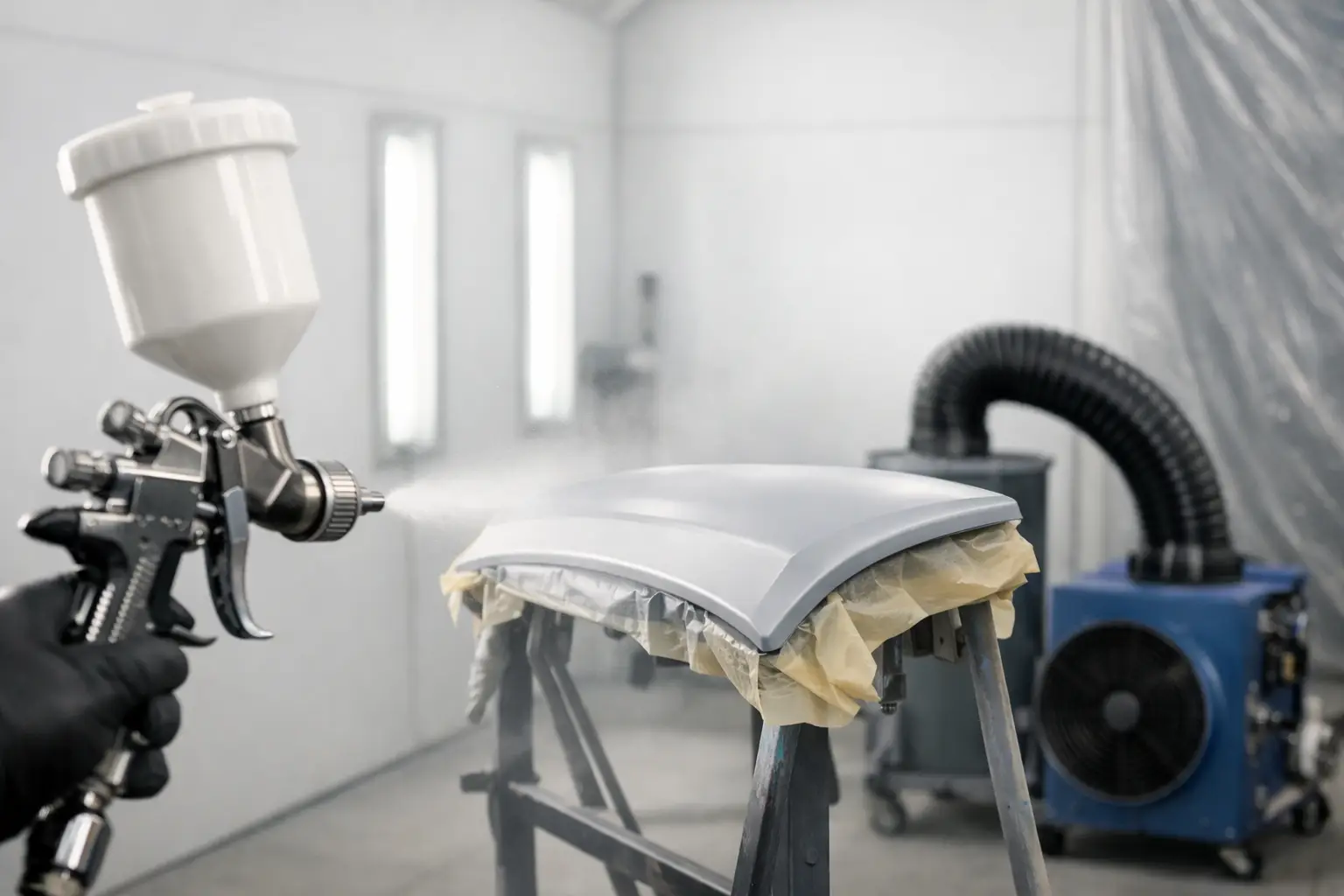
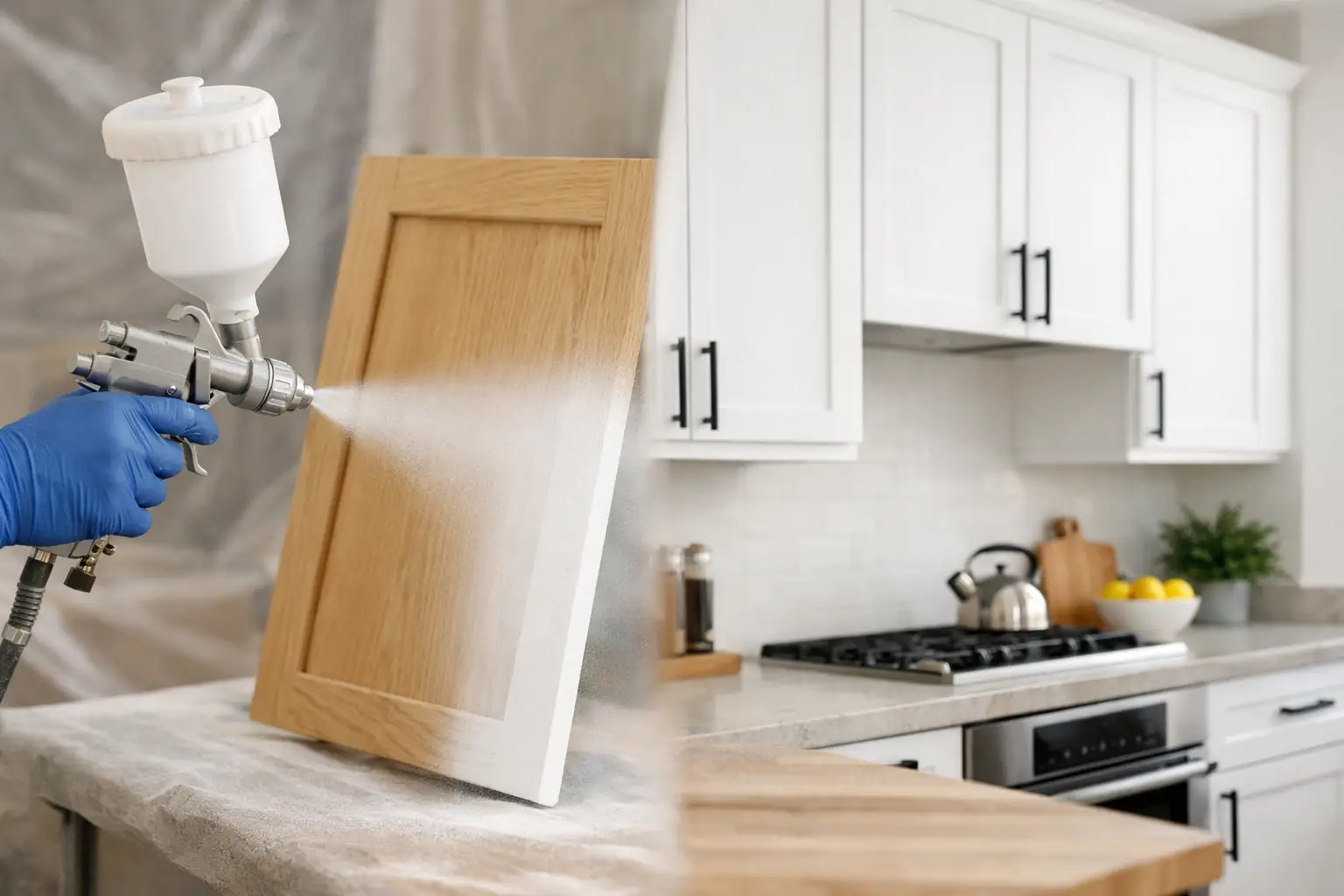
For many modern kitchens, a sprayed lacquer system is the gold standard for a hard, even finish. Spraying lays the coating down consistently without brush marks, so you don’t get weak points where the film is thin.
Solvent-based lacquers traditionally cure very hard and can be extremely tough, but they’re less popular in domestic settings now due to odour and VOC considerations. High-quality water-based lacquers have improved hugely and can offer excellent durability when applied properly and allowed to cure fully.
Trade-off: lacquer can show sharp impacts at edges (a dropped pan can still chip a corner), and deeper repairs may need a professional touch to blend perfectly.
Two-pack polyurethane (2K PU)
If your priority is maximum wear resistance, two-pack polyurethane is usually the front runner. It’s a chemically curing coating (mixed with a hardener), creating a tough film designed to handle heavy use.
In real kitchens, this matters most on high-touch areas: around handles, drawer fronts near the hob, and bins. A properly prepared and sprayed 2K PU finish is highly resistant to scuffs, many cleaning products, and everyday moisture.
Trade-off: it’s not a casual DIY product. Mixing ratios, pot life, spray technique, and safe handling all matter. It also needs the right primer underneath for proper adhesion.
Factory-style foil or vinyl wrap (and why it fails)
Many kitchens installed during the boom years have foil-wrapped doors. The surface can look flawless… until heat and steam reach an edge and the wrap begins to lift. Once it starts, it usually spreads.
Wrap isn’t “bad” in theory — it’s just less forgiving in real kitchens where a dishwasher vents steam and kettles boil daily.
Trade-off: wrap is hard to repair invisibly, and re-wrapping often isn’t cost-effective compared with respraying.
Oil-based enamels (traditional brush paints)
Oil-based paints can dry to a hard finish, and they were once a common choice for cabinets. The issue is yellowing over time (especially in lower light), slower curing, and a tendency to show brush marks unless applied expertly.
Trade-off: you can get a durable result, but it’s harder to achieve a consistent, modern factory look, and the downtime can be longer.
Water-based “cabinet paint” for DIY
There are decent water-based cabinet paints on the market. They’re convenient and lower odour, and they can look lovely.
However, for the best kitchen cabinet finish for durability, DIY products are often limited by two realities: they’re usually formulated to be forgiving rather than maximally tough, and they’re commonly applied with a roller/brush where thickness varies.
Trade-off: great for quick refreshes, less ideal for a long-term, heavy-use family kitchen unless prep and curing are handled carefully.
Durability depends more on the system than the label
It’s tempting to ask, “Which paint is best?” but professionals look at the full stack:
1) Surface preparation and degreasing
Kitchen doors hold years of invisible residue. If grease remains, the best coating in the world can fail by peeling or chipping. Proper degreasing is slow, methodical work — especially around handles and near the cooker.
2) Keying (sanding) and edge attention
Most wear starts at edges. Edges get knocked, scrubbed, and caught by rings. A thorough key and careful sanding profile helps coatings grip properly, and it reduces the chance of brittle build-up that chips.
3) The right primer for the substrate
MDF, solid timber, laminate, and previously painted doors each behave differently. A professional primer isn’t just “undercoat” — it’s an adhesion bridge and moisture controller. Get this wrong and you’ll see peeling at corners first.
4) Spraying technique and film build
Even film thickness matters. Too thin, and you don’t get a protective layer. Too thick, and edges can look heavy or become more prone to impact damage.
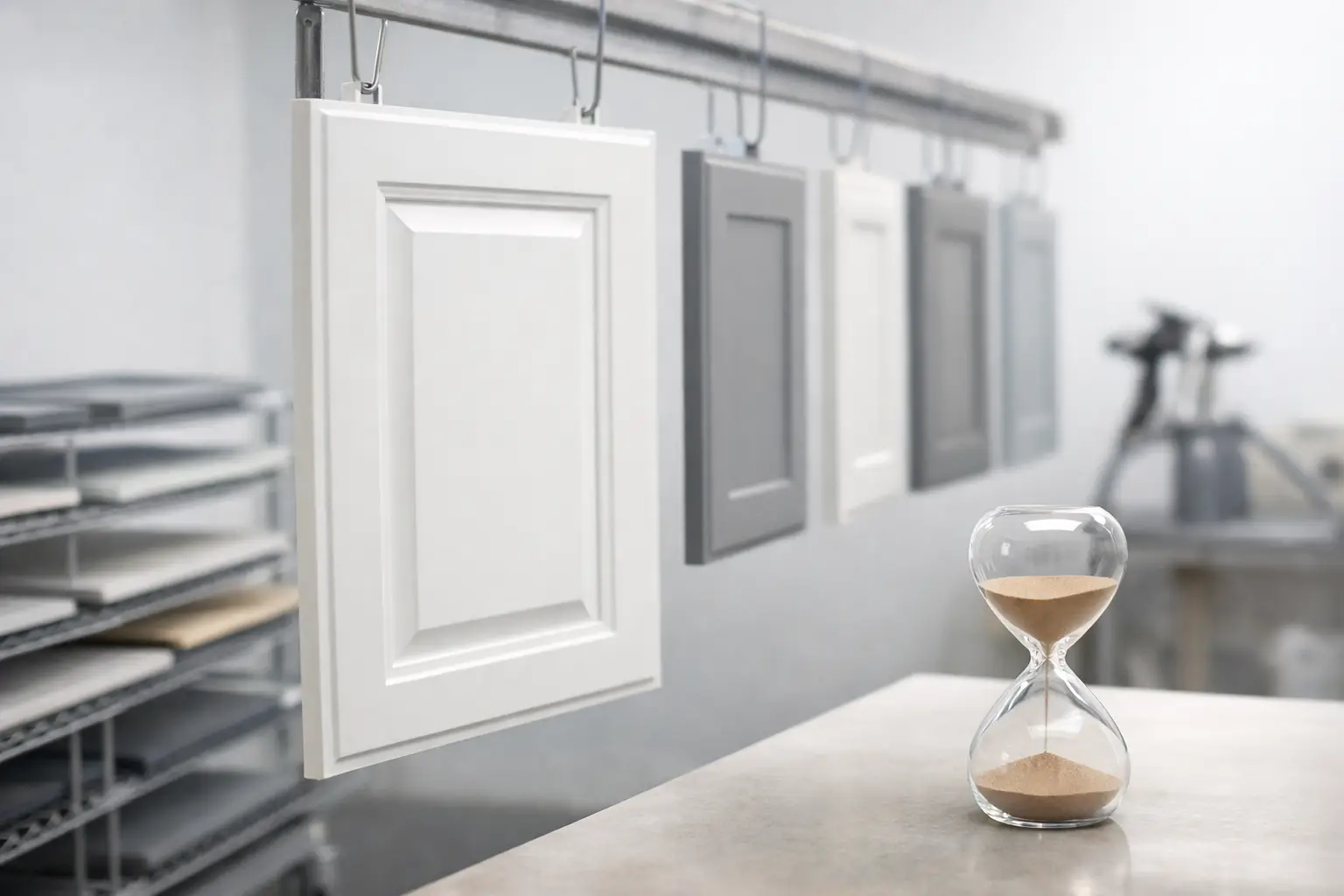
5) Curing time (the part people underestimate)
Dry-to-touch is not cured. A finish may feel fine in a few hours but takes days (sometimes longer) to reach full hardness. This is where homeowners accidentally mark a new finish by re-hanging doors too soon, stacking items against them, or scrubbing early.
Choosing the right sheen for real life
Sheen affects both appearance and practicality.
A matt finish can look stunning and contemporary, and it hides minor surface imperfections. But it can show burnishing (shiny patches) in high-touch areas over time, depending on the product.
Satin is the workhorse for most busy kitchens: it’s forgiving, wipes clean well, and doesn’t highlight fingerprints as much as gloss.
High gloss is dramatic and easy to wipe, but it shows scratches and swirl marks more readily, particularly on darker colours.
If you want that “just sprayed” look for longer, satin is often the sweet spot for durability and day-to-day cleanliness.
The real-life “best” choice by kitchen type
For a typical family kitchen in Dublin, Wicklow, Kildare, Meath, or Louth — with constant cooking and cleaning — a professionally sprayed system using a high-quality lacquer or 2K PU coating is usually the strongest bet.
If your kitchen is lightly used, you may prefer a water-based sprayed lacquer for lower odour and an eco-friendlier profile, provided the prep and primer system is right.
If you have foil-wrapped doors that are lifting, it’s worth addressing the underlying issue (often heat/steam exposure) and choosing a finish that won’t delaminate in the same way.
And if your doors are solid timber with visible grain you’d like to keep, a clear or tinted system may be possible — but durability will still depend on sealing and edge protection as much as the topcoat.
How to keep a durable finish looking new
Even the toughest finish benefits from sensible care. Use a soft microfibre cloth and mild detergent for routine cleaning. Avoid abrasive pads, harsh solvents, and “miracle” degreasers that leave residues or dull the sheen.
Also, give your new finish time. For the first couple of weeks, treat it like a fresh worktop: gentle wiping, no aggressive scrubbing, and avoid hanging damp cloths over doors where moisture can sit along an edge.
When respraying makes more sense than replacing
If your cabinets are structurally sound (doors align well, hinges aren’t pulling out, carcases are solid), respraying can deliver a like-new finish without the disruption of a full rip-out. It’s also the eco-friendly option: you’re keeping good materials in place and reducing waste.
A trusted, professional respray is particularly valuable if durability is your number one concern, because the finish is only as good as the preparation, spray environment, and curing process. That’s exactly the kind of work we focus on at Dublin Kitchen Respray, helping homeowners get a stunning transformation that’s designed to cope with real kitchens — not showroom kitchens.
The best part is psychological as much as practical: you stop worrying about every mark because the finish is built to be lived with.
What to ask before choosing a finish
If you’re comparing options, ask what primer will be used for your specific door type, what topcoat system is being applied (and why), how long curing will take, and what aftercare is recommended.
A professional should be comfortable explaining trade-offs: for example, a deeper matt may look beautiful but may not be the best choice for a high-traffic household with young children; a high-gloss dark colour may be wipeable but more scratch-revealing.
The right answer isn’t always the hardest coating available — it’s the coating that fits your kitchen habits, your preferred look, and the level of maintenance you’re willing to do.
A helpful way to think about it is this: choose a finish you won’t be afraid to use. The most durable cabinet finish is the one that still looks great after countless busy mornings, not the one that only looks perfect when nobody touches it.